The NRW Certificate
The Centre of Higher Education Development (ZHD) of the Faculty of Human Sciences is part of the network of higher education NRW, which is an association of 15 didactical centres and working premises at North Rhine-Westphalian universities, administrative colleges and some colleges of art and music.
Being a member of the network "Hochschuldidaktik NRW", we offer lecturers and interested junior researchers the opportunity to participate in the qualification programme "Professional Teaching Skills for University." This includes a well-founded initial didactic qualification and is completed with a certificate. The NRW certificate officially confirms the pedagogical suitability of its holders, as it is required by many universities within the teaching profession.
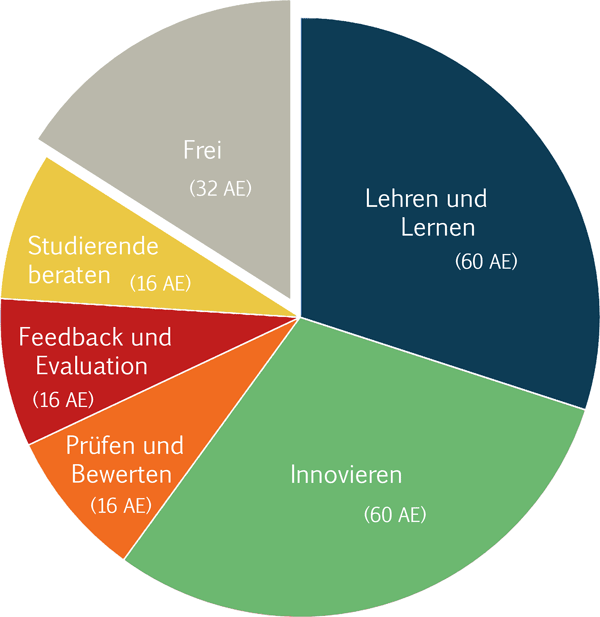
The NRW certificate, with 200 work units (AE) in total, consists of three modules: a basis module (80 AE), an extension module (60 AE) and a specialism module (60 AE) and thus complies with national and international standards. The AEs are acquired through taking part in workshops (WS), cooperative work shadowing (KoHo) and through an innovative teaching project.
Within the modules, all subject areas with defined compulsory work units must be completed. The following compulsory work units apply:
• teaching and learning: a minimum of 60 AE
• examining and assessing: a minimum of 16 AE
• guiding students: a minimum of 16 AE
• feedback and evaluation: a minimum of 16 AE
• developing innovations in teaching and studies: a minimum of 60 AE
Basis modul (80 AE)
The basis module (80 units) serves to build up basic knowledge about teaching and learning, examination and assessment, and the planning of courses in university teaching. The 80 units are composed as follows:
- participation in the workshop "Teaching and Learning" (16 AE)
- participation in the workshop "Planning courses" (8 AE)
- implementation of cooperative work shadowing including a report (8 AE)
- participation in collegial case consultation (4 AE)
- 8 work units from the subject area feedback & evaluation (8 AE)
- 4 additional work units from the topic area of guiding students (4 AE)
- 32 work units are freely selectable (but ideally already with a view to the requirements of the extension module). (32 AE)
Extension module (60 AE)
In the extension module (60 units), building on your basic knowledge, you have the opportunity to deal in depth with specific topics of university didactics, such as setting and effectively correcting exams, meaningfully integrating types and forms of portfolio work into your own teaching, making lectures attractive, etc.
In order to successfully complete the extension module, a total of 140 work units (in basis and extension module together) must have been achieved. The following requirements apply:
- teaching and learning: 60 AE
- examining and assessing: 16 AE
- guiding students: 16 AE
- feedback und evaluation: 16 AE
- selectables: 32 AE
Specialism module (60 AE)
In the specialism module (60 AE), you develop a concept for one of your courses and deliberately try out something new that you learned about in the certificate program. You reflect on and document the integration of this innovation into your teaching over the course of a semester and submit it in bundled form to the ZHD in a so-called project report. In addition, you will attend a workshop that deals specifically with the requirements of the in-depth module.
Procedure of the project module:
- consultation with an employee of the ZHD
- planning of the project and preparation of a project outline
- project approval by the employee in the ZHD
- implementation of the project
- cooperative work shadowing/ collegial consultation as well as feedback and evaluation
- written documentation and reflection of the project
Parallel to the course of the project, the workshop "Modul 3" is attended. The workshop can be attended at any time during the course of the project.
The certificate program explained (video, in german)
Structure
I. Basis module (80 AE)
The basis module (80 AE) is designed to gain basic knowledge about teaching and learning, assessment as well as planning courses in higher education. Compulsory elements that should be completed in this module are:
- participation in the workshop "teaching and learning"
- participation in the workshop "planning educational events"
- carrying out cooperative work shadowing including a report
- participation in a collegiate case consultation
II. Extension module (60 AE)
In the extension module (60 AE), based on the basic knowledge, you have the opportunity to take a closer look at specific topics of higher education didactics, such as: setting exams and correcting them effectively, meaningfully integrating types and forms of portfolio work into your own teaching and variegating lectures.
III. Specialism module (60 AE)
In thespecialism module (60 AE), you develop a concept for one of your courses and deliberately try out something new, that you learned about in the certificate programme. You reflect on and document the integration of this innovation into your teaching over the course of a semester and submit it i to the ZHD in a so-called project report. In addition to that, you will attend a workshop that deals specifically with the requirements of the in-depth module.
Procedure of the project module:
- consultation with an employee of the ZHD
- planning of the project and preparation of a project outline
- project approval by the employee in the ZHD
- implementation of the project
- cooperative work shadowing as well as feedback and evaluation
- written documentation and reflection of the project
Parallel to the course of the project, the workshop "Module 3" is attended. The workshop can be attended at any time during the course of the projec
IV. Final interview
After submitting the report on the specialism module project, you will have a final interview with a ZHD-employee about the teaching project carried out and the personal development of the framework of the certification program. After completing this interview, you will receive the NRW certificate "Professional teaching competence for the university".
Topics
1. teaching and learning
Designing teaching, motivating and activating students for learning, and initiating learning and understanding it as a process - these are the core tasks of every teacher. Against this background, it is important for teachers to deal with the fundamentals of teaching and learning. Thus, the question of how teaching and learning processes are related and what this means for the design, planning, implementation and reflection of your own teaching.
2. examining and assessing
Exams are an essential part of the degree programme and fulfill selective, didactic and motivational functions. Even teachers who do not take exams themselves contribute to the acquisition of competence and the competence assessment in the sense of Constructive Alignment. Therefore, the aim of the thematic field is to make teachers aware of the importance of university examinations in the entire learning process of the students and to enable the establishment of a methodological repertoire for the conception and execution of examinations.
3. guiding students
Counselling for students is part of the basic teaching of higher education and covers a very wide range of subject-related as well as academic topics. In order to be able to offer counseling on an ad-hoc, appreciative, time-economic and goal-oriented basis and to support students on their way to academic success in an appropriate framework, teachers develop an individual counseling position in the field of "guiding students" that is based on professional standards.
4. feedback and evaluation
Giving and receiving feedback is an essential part of teaching - between teachers and students as well as in collegial exchange. By enabling faculty members to engage in appreciative exchange with all the relevant actors of the higher education institution, they promote the development of quality of their own teaching in particular and of teaching throughout the university in general. They learn about feedback and evaluation procedures and develop adaptation options for their own teaching.
5. developing innovations in teaching and studies
The aim of this subject’s area is the transfer of acquired didactic competencies to the own teaching and research context as part of an innovative teaching / learning project. Teachers are sensitised to the fact that concepts once learned are not static, but need continuous development through evaluation and reflection.
The Centre for Advanced Teaching and Learning belongs to the network "Hochschuldidaktik NRW" (Higher Education North-Rhine-Westphalia). Through the association between centres of Higher Education and workplaces in NRW, the ZHD can offer a participation in the further education programme "Professional teaching competence for the university" to all teachers of University of Cologne. It includes a sound basic didactic qualification and finishes with a certificate. Within the network "Hochschuldidaktik NRW", further qualifications are coordinated, e.g. for tutors in university teaching and university didactic coaches.